
Typical reply
What is the price?
It’s $139.
✕Price without explanation
Without scripts, pressure, or sounding like a bot
Inbox to Revenue shows you how to understand what buyers really mean, what to say next, and how to keep the conversation moving toward a sale.
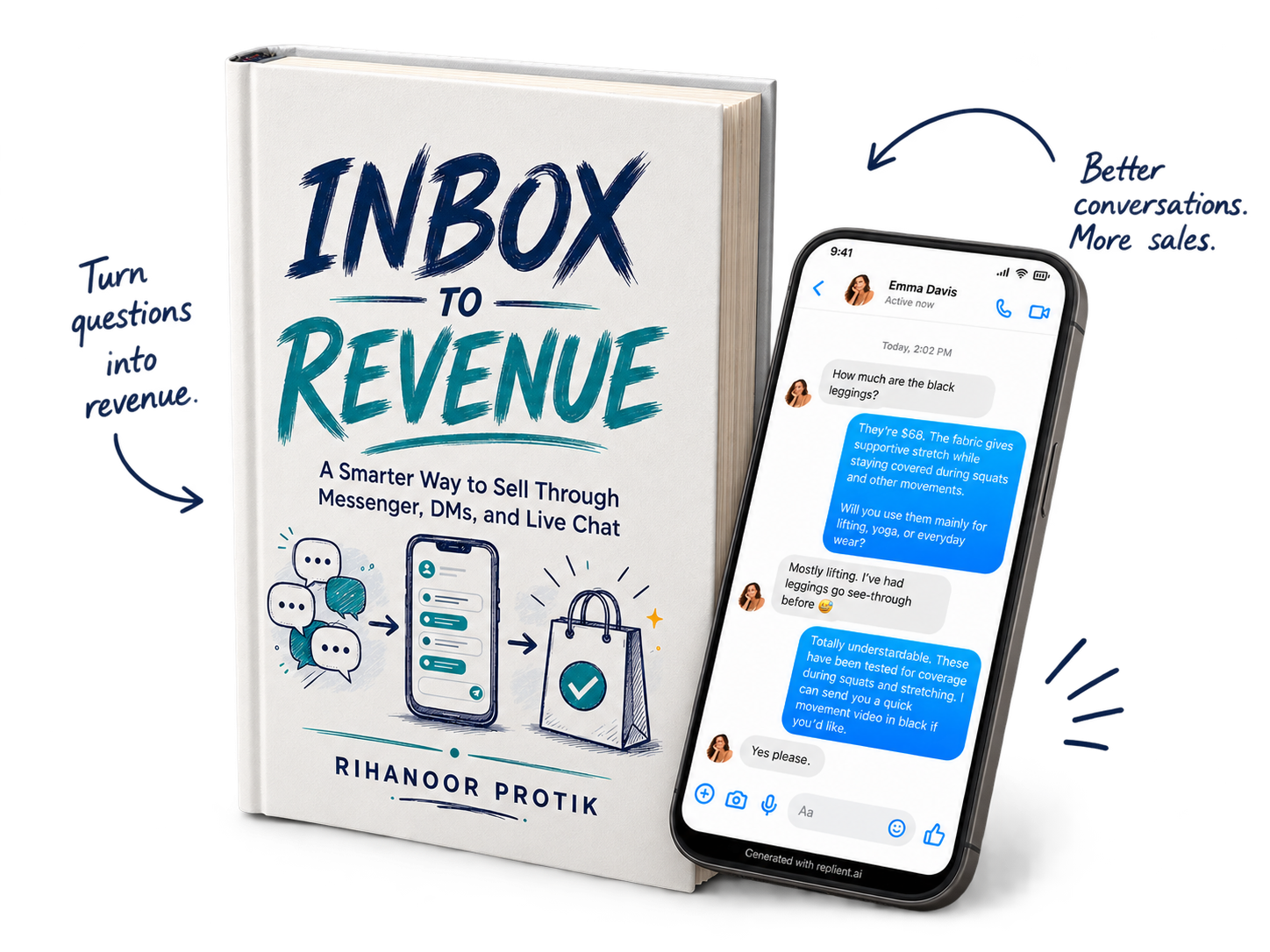
Understand what buyers
actually mean
Answer with relevance
that builds trust
Guide the next natural
step to the sale
8 Chapters
Digital eBook (PDF)
Instant Access
Practical frameworks
for modern
online stores
Actionable system
you can use
immediately
No fluff. No scripts.
Just what works.
The PULSE framework helps you uncover intent behind short, unclear, or repeated questions.
Say the right thing at the right time, without scripts or pushy sales tactics.
Use clarity and empathy to handle objections and keep conversations moving forward.
Turn everyday messages into consistent, profitable checkouts.
You can fix the product, sharpen the offer, and tune the campaign. And still lose the buyer inside a conversation nobody ever reviews.
Budget goes out and a real, interested person shows up.
“How much?” “Is it good?” “Will it fit?” That’s a buying signal worth handling well.
A bare number, a wall of detail, or a push to buy before the doubt is settled.
THE MOST EXPENSIVE LOSS
The ad did its job. The reply didn’t. The buyer reached a point where they needed help deciding, and the conversation gave them nowhere to go.
You won’t see this leak in your ad dashboard. It just looks like another visitor who didn’t convert.
Three conversations that cover the objections that actually kill inbox sales:
price, trust, and delay. Read the left thread, then the right one.
How much is the moisturizer?
It's $32.
How much is the moisturizer?
It's $32. It gives dry skin lasting hydration without feeling heavy or greasy.
Does your skin feel dry throughout the day, or mainly after washing your face?
The seller answered the price directly, connected it to one relevant benefit, and asked an easy question to keep the conversation moving.
Will this work for sensitive skin?
Yes, it's very good.
Will this work for sensitive skin?
It's made to hydrate without feeling harsh, and many customers choose it when they want something gentle for daily use.
Is your skin usually sensitive to fragrance, or more to heavy creams?
The seller reduced uncertainty, added useful context, and asked a low-friction question that helps guide the recommendation.
Okay, I'll think about it.
Okay.
Okay, I'll think about it.
Of course. Just so it's easier to decide, this one is best for dry skin that needs hydration without a heavy feel.
If you want, I can also tell you whether it's better for daytime or nighttime use.
The seller did not push. They reduced decision friction and reopened the conversation with a helpful next step.
Typical reply. customer: How much is the moisturizer? seller: It's $32.
Smarter reply. customer: How much is the moisturizer? seller: It's $32. It gives dry skin lasting hydration without feeling heavy or greasy. Does your skin feel dry throughout the day, or mainly after washing your face?
What changed? The seller answered the price directly, connected it to one relevant benefit, and asked an easy question to keep the conversation moving.
Typical reply. customer: Will this work for sensitive skin? seller: Yes, it's very good.
Smarter reply. customer: Will this work for sensitive skin? seller: It's made to hydrate without feeling harsh, and many customers choose it when they want something gentle for daily use. Is your skin usually sensitive to fragrance, or more to heavy creams?
What changed? The seller reduced uncertainty, added useful context, and asked a low-friction question that helps guide the recommendation.
Typical reply. customer: Okay, I'll think about it. seller: Okay.
Smarter reply. customer: Okay, I'll think about it. seller: Of course. Just so it's easier to decide, this one is best for dry skin that needs hydration without a heavy feel. If you want, I can also tell you whether it's better for daytime or nighttime use.
What changed? The seller did not push. They reduced decision friction and reopened the conversation with a helpful next step.
These conversations are written illustrations of the method, not customer records.
Select all that sound familiar. Your result updates as you go.
These aren’t small mistakes.
They’re patterns that quietly kill conversions.
The good news? Every one can be fixed with the right approach.
That’s exactly what this book teaches.If you recognized your own inbox above, you already know what needs fixing. Inbox to Revenue shows you what to do instead.
Get the PDF immediately.
Short, clear, and easy to apply.
Read it. Apply it. Decide for yourself.
A SMARTER WAY TO SELL THROUGH MESSENGER
THE MECHANISM
The smarter replies you saw above follow five decisions. Together, they make PULSE.
Here’s one reply with all five marked.
Is this the same as the one on the other page? That one’s cheaper
What is actually happening here?
They are comparing two listings, not simply haggling. Recognize the confusion before explaining anything.
Why it works: Stops the reply from sounding defensive.
What are they trying to decide?
They’re trying to work out why this one costs more and whether the difference is worth it.
Why it works: Now you can answer the decision behind the question.
Why is this relevant to them?
Connect the choice to a real outcome they already told you.
Why it works: One line that changes their math, not a feature list.
What would make this feel safe?
Remove the unspoken doubt so the choice is easy to make.
Why it works: The buyer has less uncertainty to carry.
What should happen next?
Give two simple paths and an easy reply.
Why it works: No pressure, no thread left hanging.
Most inbox sales are lost by answering the literal question perfectly.
Eight of the most common messages, and the decision usually sitting underneath them.
They are deciding whether it feels worth the money — not asking for a number in isolation.
They want something concrete they can check, because they have been burned before.
Something specific is unresolved and they have not said what it is yet.
They want guidance so they do not have to carry the risk of choosing wrong.
There may be a deadline behind this. Timing can be the entire condition of the sale.
They are pricing the cost of being wrong before they commit.
They are comparison shopping and want a reason to stop looking.
The number landed before the value did. Nothing was rebuilt around it.
From reading buyer intent to handling doubt, follow-up, and the next step.
WHY CONVERSATIONS DIE
Spot where a conversation starts losing momentum, while there is still time to change the reply.
UNDERSTANDING BUYER INTENT
Tell whether someone is comparing, uncertain, or ready to move forward.
BETTER PRODUCT REPLIES
Answer product questions with useful context instead of giving the buyer a bare fact.
THE PULSE FRAMEWORK
Run an incoming message through five decisions before deciding what to say.
HANDLING DOUBTS
Know what to do when a buyer hesitates instead of immediately pushing or letting the conversation die.
MOVING TOWARD THE SALE
Offer a next step that feels like help rather than pressure, and know when to offer it.
THOUGHTFUL FOLLOW-UP
Follow up with a reason to reply instead of ‘still interested?’, and know when not to.
APPLYING THE SYSTEM AT SCALE
Turn your best replies into a standard someone else on the team can follow.
PULSE gives you a clearer way to decide what the buyer needs at each point in the conversation.
Guess what to say next
Answer only the literal question
Push or over-explain when doubt appears
Follow up without context
Depend on one person’s instinct
Diagnose intent before replying
Respond to the decision behind the words
Use relevant proof to settle the real doubt
Reconnect with a useful reason
Give the team a repeatable standard
FRAMEWORK IN PRACTICE
Three common conversation challenges — hesitations on price, product uncertainty,
and team consistency — handled with structured intent.
Sample Scenario: Re-engaging Inquiries
When buyers go quiet after asking for details, a context-driven follow-up addressing the underlying fit or timing concern invites a natural reply instead of a high-pressure reminder.
Sample Scenario: Pricing & Comparison
When a buyer asks about price or comparisons, answering the decision behind the question clarifies product distinction before the conversation reaches a dead end.
Sample Scenario: Shared Standards
Standardizing responses around context, value, and clear next steps ensures every team member handles common product questions with consistent clarity.
Moving past “I’ll think about it” starts by clarifying unresolved questions rather than ending the conversation prematurely.
Takeaway: HesitationDirect answers paired with relevant context make pricing clear without putting unnecessary pressure on the buyer.
Takeaway: Price QueriesUnderstanding the decision process allows sellers to write natural replies tailored to each customer’s specific inquiry.
Takeaway: Beyond ScriptsOffering two clear, low-friction options keeps momentum moving forward instead of relying on generic reminders.
Takeaway: Next StepsA shared decision framework aligns team responses across live chat, DMs, and support tickets.
Takeaway: Team ClarityHelpful, informative replies build trust faster than aggressive closing tactics.
Takeaway: Tone & RelevanceAddressing what the customer is actually deciding turns brief messages into constructive conversations.
Takeaway: Intent DecodingStructuring replies around context and next steps keeps conversations productive from first message to purchase.
Takeaway: Chat MomentumIf customers ask questions before they buy, this will tell you quickly whether the book fits how you sell.
One payment. Instant download. Keep it open beside the conversations you already have.
All 8 chapters of Inbox to Revenue in one practical guide.
Five decisions to help you work out what the buyer needs before you reply.
A practical guide to what common price, quality, fit, delivery, and return questions may really mean.
Before and smarter-reply examples with the thinking behind each response.
When to reconnect, what to say, and when it is better to leave the conversation alone.
A repeatable way for someone else on the team to think through customer messages.
Instant download · PDF · Any device
Read it. Apply it. If it is not useful for you, let us know within 14 days for a full refund.




REMAINING DOUBT
Smart questions lead to better results. Here are the most common ones—answered clearly.
This system is built around buyer intent, not one product type.
If your customers ask about price, quality, fit, delivery, or returns before they buy, the decisions are the same whether you sell apparel, electronics, homeware, or a service.
The worked examples span several categories so you can see how the method transfers rather than having to guess.
Low volume makes each conversation worth more, not less. If you get ten buying questions a week and the book helps you keep one that would have gone quiet, it has paid for itself many times over at $19. High-volume sellers get consistency from it; low-volume sellers get the individual sale.
No, and that is deliberate. Scripts break the moment the customer says something the script did not anticipate. Inbox to Revenue teaches the decision process first, then shows worked conversations so you can see why a reply works. You will be able to write your own, for your product, in your voice.
The PULSE framework is one chapter and takes about ten minutes to read. You can apply it to the next real message in your inbox before you finish the book. The remaining chapters deepen it — handling doubt, following up, and turning it into a team standard.
A digital eBook in PDF, 8 chapters, delivered as an instant download after checkout. It reads on a phone, tablet, or computer. Exact page count and file size are listed on the checkout page.
You can use it to train your own team — that is what the final chapter is for. The purchase includes a personal, single-customer license, which means one buyer rather than redistribution. If you need to hand copies to a large team, email us before purchasing and we will tell you where the line is.
Email us and we will fix it. Delivery failures, corrupted files, duplicate charges, and materially incorrect products are all covered under the published Refund and Digital Delivery policies. A broken file is our problem, not yours.
Every purchase is backed by our 14-day money-back guarantee. Read the book, test the PULSE framework in your real customer conversations, and if you do not find it practical or valuable, email us within 14 days of purchase at hello@systemsbureau.com. We will issue a full refund to your original payment method promptly and without hassle.
No. The principles apply to Facebook Messenger, Instagram DMs, WhatsApp-style selling, and website live chat, because they are about the buyer’s decision rather than the software. Where a platform limitation genuinely matters, the book says so.
It assumes you sell something and answer your own messages. It does not assume sales experience. If anything it is easier to apply early, before you have built habits you later have to unlearn.
We’re here to help. Reach out and our team will get back to you.
They asked. You will reply with something. The only question is whether that reply helps them decide or quietly ends it.
One payment • Instant download