

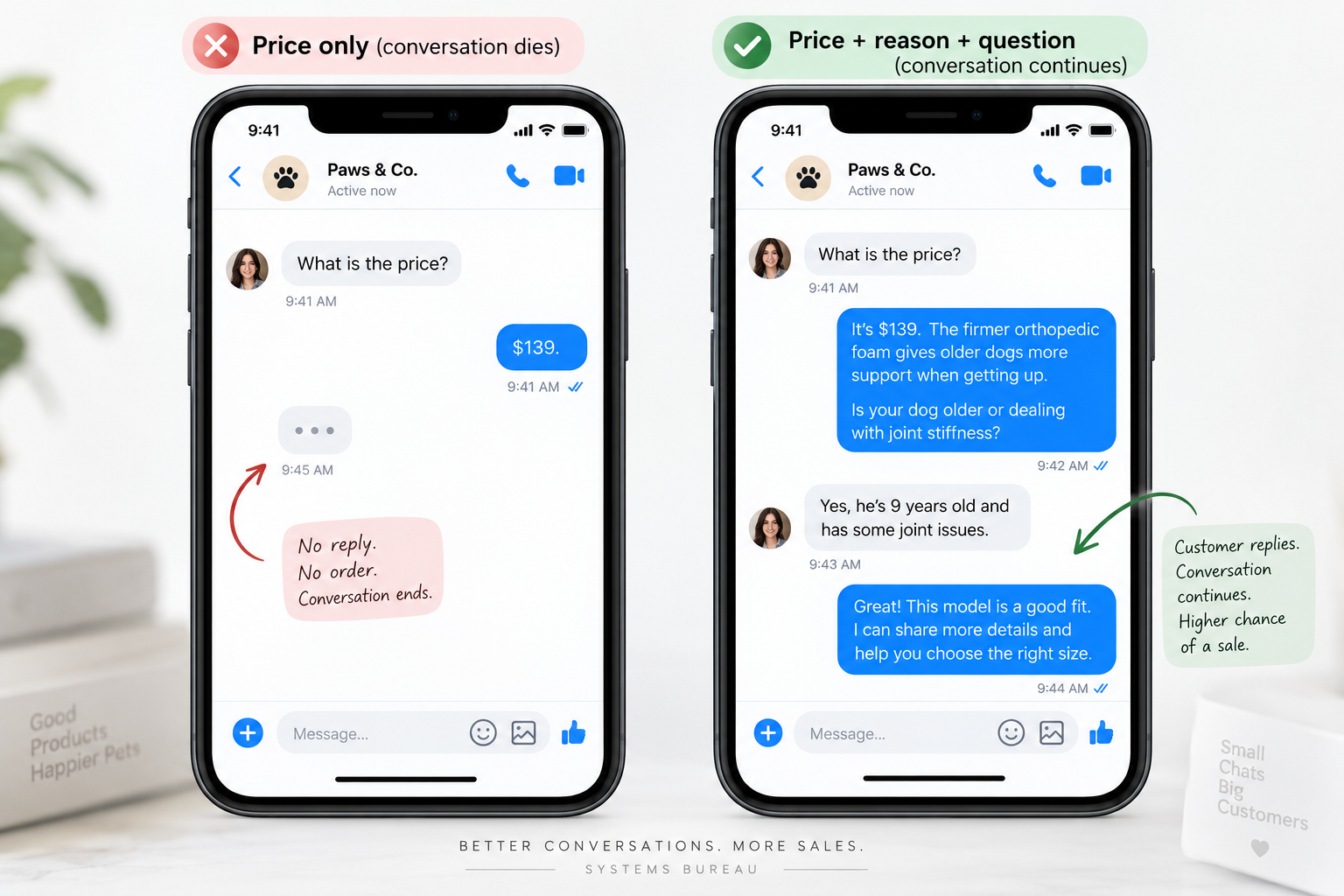
A customer sends you a message:
What is the price?
It’s $139.
Then nothing happens. No reply, no order, no question. A lot of businesses read this as proof that the price was too high, and sometimes it is. Often, though, the problem is that the customer received a number with no reason to care about it.
This article shows a better way to answer “What is the price?” without hiding the price, writing a sales pitch, or sounding pushy. The examples and prices in it are illustrative.
The Short Answer
Give the price first, add one reason that explains it, and finish with a question the customer can answer easily. That structure is Price + Reason + Relevant Question. It keeps the reply short enough for chat, gives the number some meaning, and turns a one-message exchange into a conversation you can actually guide.
The Biggest Mistake: Sending the Price Alone
When someone asks for the price, answer the question. Do not hide it, make them ask twice, write a long paragraph before the number, or reply with “Check inbox.” Answering quickly matters, but answering quickly does not mean sending only the number.
What is the price?
$139.
Technically, the business answered. But the customer now has a number and no reason why the product is worth it. So they compare it with something cheaper, close the chat, tell themselves they will think about it, or message another store. The conversation stops before the product has had a fair chance.
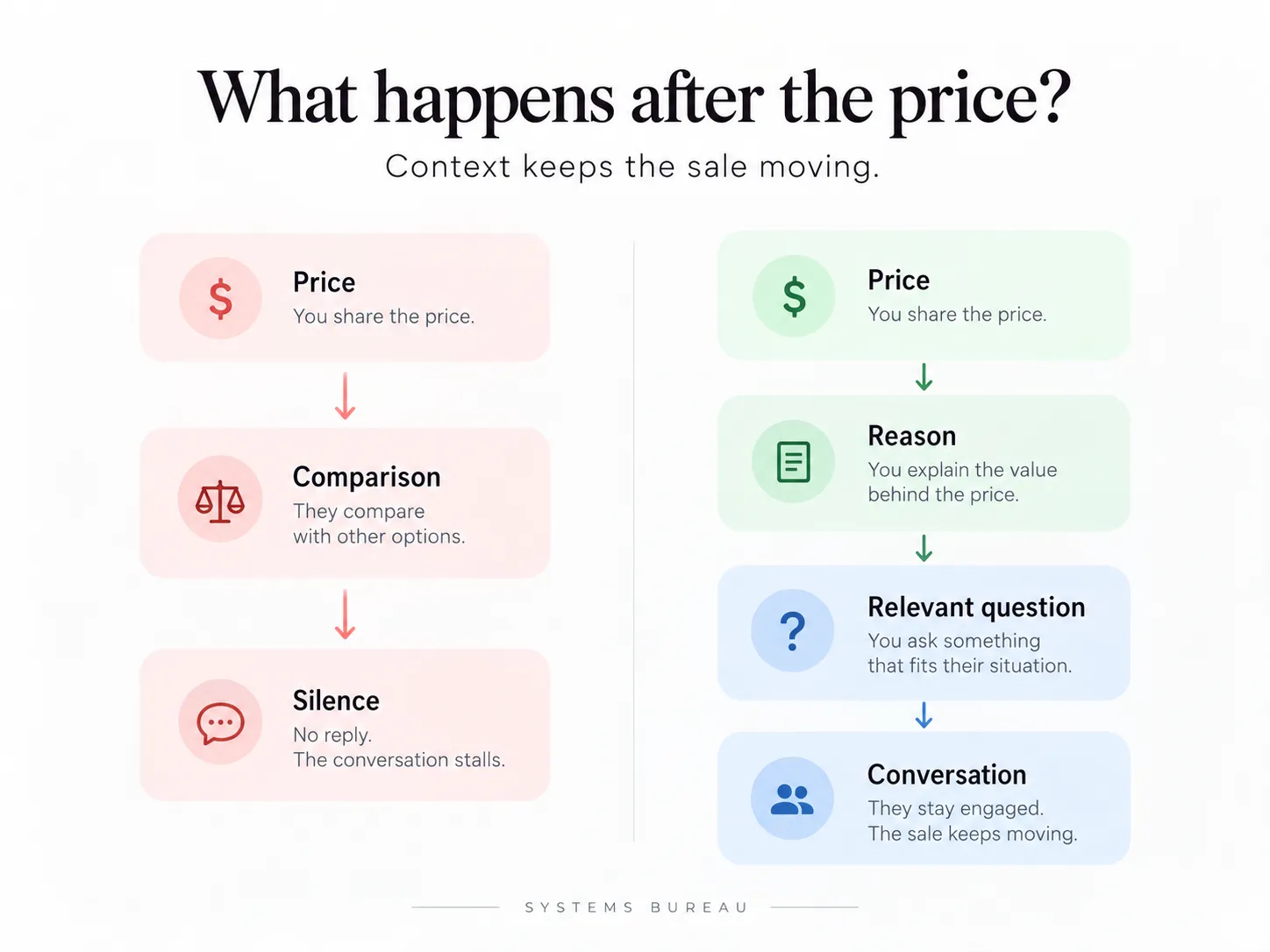
Price Without Context Becomes a Comparison
A price on its own is hard to judge. Decision researchers call this an evaluability problem: Christopher Hsee’s evaluability hypothesis explains how people judge an attribute differently when it is hard to evaluate by itself, so they lean on whatever comparison is nearby. In a sales chat, that comparison is usually a cheaper listing or the price they expected.
Imagine two stores sell similar products:
$139.
It’s $139. The difference is the firmer orthopedic foam, which gives older dogs more support when getting up. Is your dog older or dealing with joint stiffness?
Both stores gave the price. Store B also gave the customer a way to understand the number and an easy reason to reply. Store A gave a number. Store B helped the customer make a decision.
A Better Way to Answer “What Is the Price?”
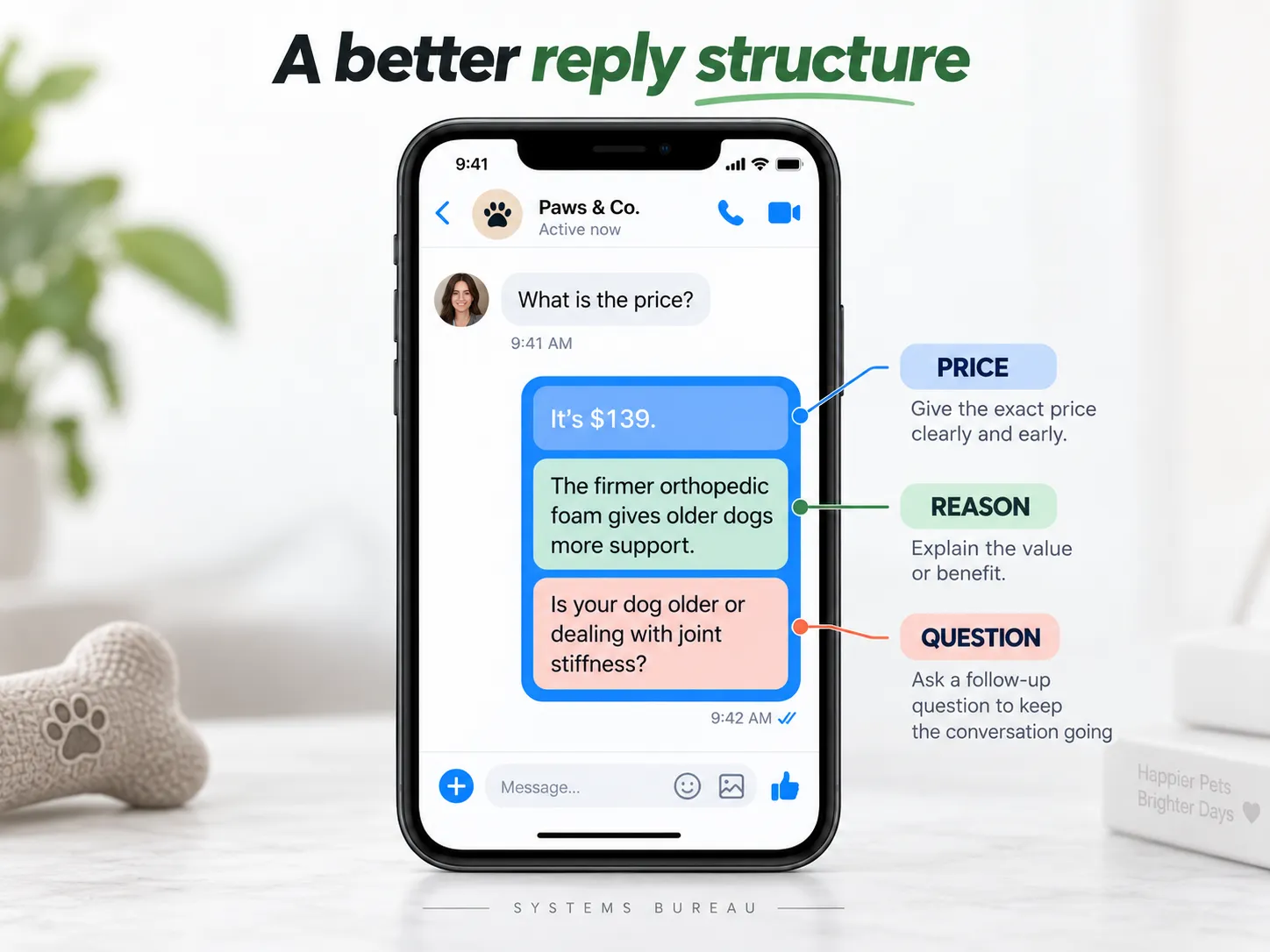
A simple structure works in many sales conversations:
You do not need a ten-step script or any pressure. You only need to help the customer understand what the price means.
Step 1: Give the Price
Answer the question first. If the item is $59, say it is $59. Making people work to find the price creates friction, and a simple question deserves a simple answer.
Step 2: Give One Reason
Next, give one useful reason behind the price. Not five features, not your company history, not a full product description. One reason, stated concretely:
It’s $59. It uses thicker waterproof material, so it holds up much better outdoors.
Specific wording does real work here. In five studies by Grant Packard and Jonah Berger, including text analysis of more than 1,000 real customer and employee interactions, customers were more satisfied, more willing to purchase, and purchased more when employees used concrete language. Customers took that specificity as a sign that the person was listening.
Step 3: Ask a Relevant Question
Finish with a question connected to what the customer may need:
Will you mainly use it indoors or outdoors?
That works better than “Are you interested?” A question about interest feels like a sales move, while a question about use feels like help. It also gives the customer an easy way to continue.
The Question After the Price Matters
A weak question can still undo a good reply. “It’s $89. It comes with a two-year warranty. Would you like to order?” jumps from price to purchase before the customer may be ready. Compare it with this:
It’s $89. It comes with a two-year warranty, which is useful if you plan to use it every day. Is this for daily use or occasional use?
Now the customer can answer without making a buying decision yet. You are not trying to close every customer in one message. You are trying to move the conversation to the next useful step.
When they answer your question, use that detail in your next reply. The next-message trick shows what that looks like with a customer who has told you how they plan to use the product.
Do Not Turn the Reply Into a Brochure
Some businesses learn that a price-only reply is weak and swing too far the other way:
Price?
Hello sir. Thank you for your interest. Our premium product is created from high-grade materials and comes with many amazing features including…
Six more paragraphs follow. The customer asked a short question, and the reply should still feel like a chat. In Messenger, Instagram DMs, WhatsApp, or live chat, short replies are easier to read, and you can always explain more after the customer responds.
One Good Reason Beats Ten Features
Customers care about what a feature means for them, not that the feature exists. “5 cm orthopedic foam” is useful information, but “the firmer foam gives older dogs more support when standing up” connects the feature to a real problem. That connection is what makes the price easier to accept.
The same translation works for most products:
- A thicker material can mean better durability.
- A faster charger can mean less waiting.
- A better coating can mean easier cleaning.
- A stronger box can mean safer shipping.
- A premium fabric can mean better comfort.
You do not need to explain everything. Pick the reason most likely to matter to this customer.
When You Do Not Know What Matters Yet
You will not always know why someone wants the product, and that is normal. Lead with the most common benefit, then let the question do the discovery:
It’s $45. This version is more durable than the standard one, especially for daily use. Are you buying it for everyday use or for something occasional?
Their answer gives you something to work with, so the next reply is no longer a guess.
Avoid Generic Questions
Some questions sound polite but add pressure or make it easy to say no: “Are you interested?”, “Do you want it?”, “Should I book your order?”, and “Anything else?” A better question helps you understand the situation:
- Is this for you or a gift?
- Will you use it every day?
- Is comfort or durability more important to you?
- Are you buying for one person or a team?
- Is your dog younger or older?
The right question depends on the product, but the rule stays the same: make it easy to answer and useful for your next message.
What If the Customer Only Writes “PP” or “Price?”
Treat it the same way, and do not punish a short message with a long reply. A customer who writes “PP?” probably wants quick information, so keep the answer short:
It’s $39. This is the heavier-duty version, so it lasts much better with regular use. Are you looking for something for daily use?
You answered the question, gave context, and opened the conversation in three sentences.
What If They Say “Too Expensive”?
Do not panic, and do not immediately offer a discount. An instant price cut can suggest that the original price was never real. Understand the objection first, because “too expensive” can mean very different things:
- “I found something cheaper.”
- “I do not understand the difference.”
- “I like it, but I cannot afford it.”
- “I am not sure it is worth it.”
- “I was expecting a different price.”
Those are different problems and need different replies. A useful first response finds out which one you are dealing with:
Totally understand. Are you comparing it with a similar orthopedic model, or were you hoping to stay under a certain budget?
You do not need to prove the customer wrong, and arguing rarely helps. Your job is to make the decision clearer. Sometimes the honest result is “this product is not right for me,” and that is fine. A good sales conversation helps the right customer see why the product may be worth choosing.
Your Reply Should Sound Like a Person
Customers see a lot of automated messages, so formal openers like “Thank you for your valuable inquiry. We are delighted to inform you that…” stand out for the wrong reason. Use simple words and short sentences, answer what they asked, and write like a helpful person:
It’s $69. This one has a stronger frame than the basic model, so it is better if you plan to use it every day. Is it for home or work?
Even if you use automation later, the message should still feel human.
Should You Send Everything in One Message?
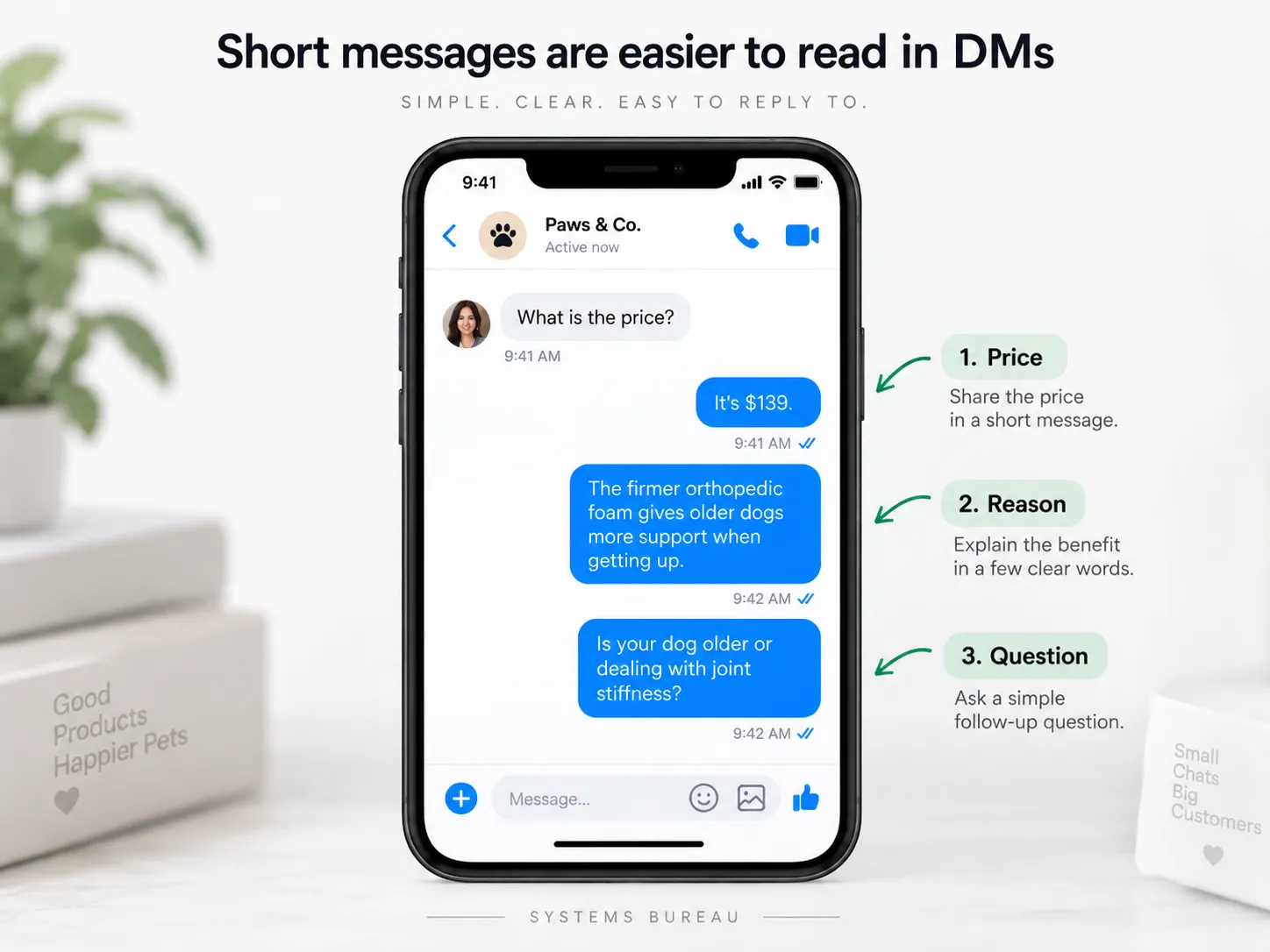
Not always. In chat, two or three short messages can be easier to read on a phone than one dense block:
It’s $139.
The main difference is the firmer orthopedic foam. It gives older dogs better support when getting up.
Is your dog older or dealing with joint stiffness?
This feels more like a real conversation and is easier to scan.
A Simple Reply Template You Can Use
Adapt this structure to your products:
Two examples:
It’s $79. The main difference is the thicker waterproof outer layer, so it handles outdoor use much better. Will you mostly keep it indoors or outside?
It’s $49. This version has a larger battery, so it lasts much longer between charges. Do you need it mainly for travel or everyday use?
The words change with each product. The structure stays the same.
To write one for your own product, use the fillable price-reply template, with examples for different types of shops.
When Should You Give More Detail?
Give more detail when the customer asks for it. If they ask what makes it different, explain the differences. If they ask about the warranty, answer the warranty question. If they ask for a cheaper version, talk about the options. A sales chat should move one step at a time, so do not dump every possible answer into the first reply.
The Goal Is Not to “Win” the Price Question
“What is the price?” is not always an objection. Often the customer is simply gathering information, which is a good sign: they have moved from looking to asking, and they are giving you a chance to help. The mistake is treating the question as the end of the conversation when it should be the beginning of a better one.
If customers often disappear after you send the number, read Why Customers Stop Replying After You Send the Price.
The Real Problem Is What Happens After the Price
Many businesses spend real money getting people into Messenger, Instagram DMs, WhatsApp, or live chat. They run ads, create offers, and design product pages, and the messages arrive. Then the whole conversation becomes “Price?” followed by “$49,” and the lead disappears. The traffic and the offer were not always the problem. Sometimes the conversation simply gave the customer no reason to keep going.
That gap is one of the main ideas behind Inbox to Revenue, the Systems Bureau guide to selling through Messenger, DMs, and live chat. The book goes deeper into what to do when customers ask about price, hesitate, lose trust, stop replying, or need a follow-up, using the PULSE framework to turn common sales chats into clearer, more useful conversations.
A Quick Check Before You Send Your Next Price Reply
- Did I answer the price question clearly?
- Did I give one useful reason behind the price?
- Did I avoid sending too many features?
- Did I ask a question that helps me understand the customer?
- Does the message sound like a real person?
If every answer is yes, your reply has a much better chance of keeping the conversation alive.
Frequently Asked Questions
Should I show the price in my post or make people message me?
If customers keep asking, showing the price usually removes friction. When the price is hidden, some people never ask, and those who do may already feel the seller is being evasive. A visible price still leaves room for the conversation, because your reply can then focus on fit and value instead of the number.
Is it okay to reply with only the price if the customer seems in a hurry?
Keep it short, but still add one reason and one easy question. “It’s $39. This is the heavier-duty version. Is it for daily use?” takes a few seconds to read and gives the customer a reason to reply.
Should I offer a discount when a customer says the price is too high?
Not as the first move. Find out what “too high” means first: a cheaper competitor, an unclear difference, a budget limit, or doubt about value. Each needs a different answer, and an instant discount can make the original price look made up.
What is the best question to ask after giving the price?
A question about how they will use the product or who it is for, such as “Is this for daily use or occasional use?” It is easy to answer, does not ask for a buying decision, and tells you which benefit to talk about next.
Final Thought
When a customer asks “What is the price?”, do not hide the price, send only the price, or turn the reply into a long pitch. Give them the number, one reason to understand it, and an easy reason to reply.
A simple price question can either end the conversation or open the door to the sale. The difference is often what you say immediately after the number.